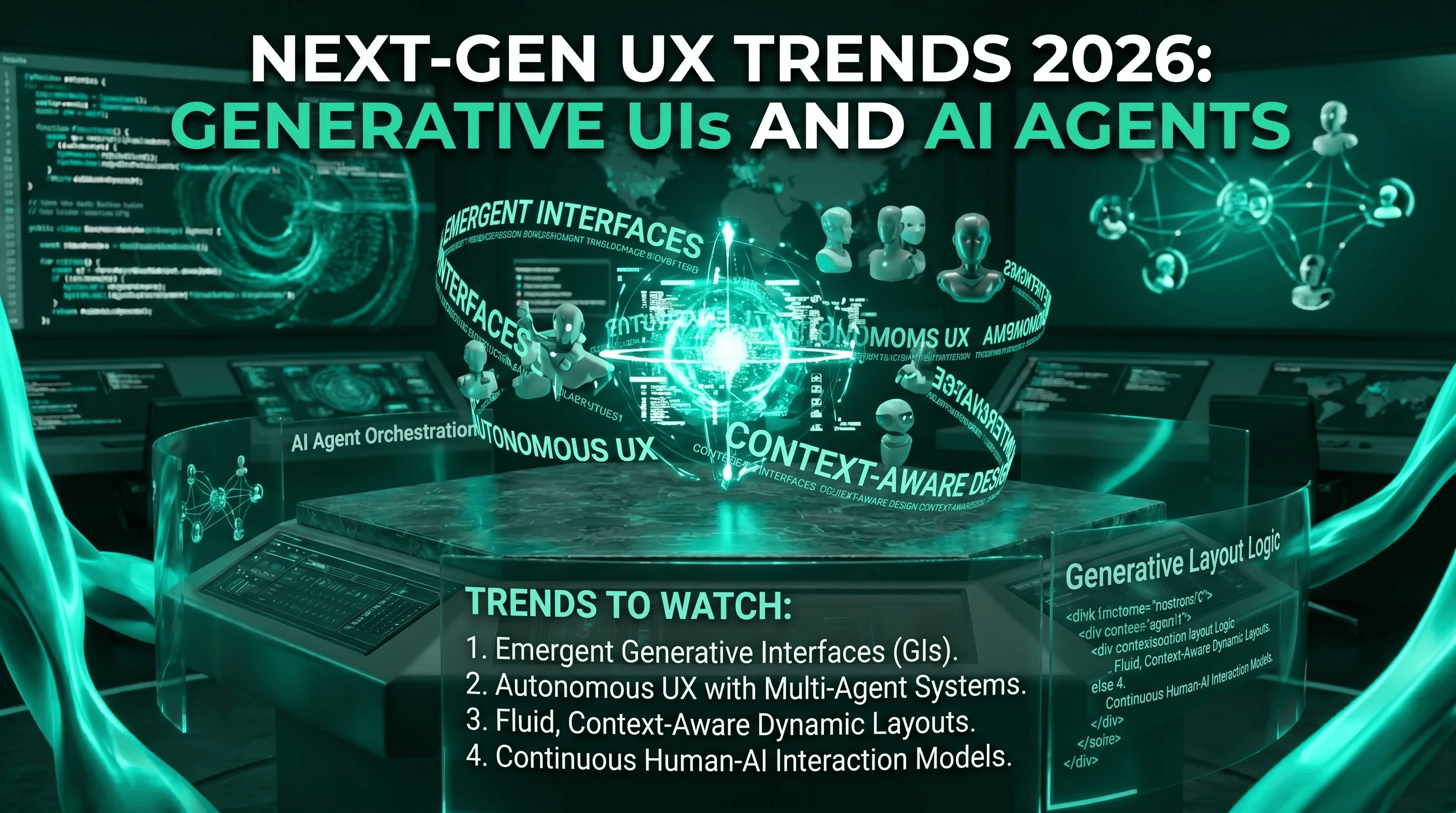
Friends, digital design is evolving each year, but it is 2026 when the fundamentally different definition of the concept of design will have been adopted. We are no longer in the ancient times when we simply run or operate apps, but living with the apps and interacting with them. Until two-three years ago, UI/UX was simply a matter of making a screen look pretty, where the buttons should be, etc, but in 2026 this line has been crossed. As a designer, developer or business owner, you will have to come to terms with the scathing truth that UI/UX is no longer a game of colors, shapes and typography it is a deep integration of Artificial Intelligence and Humanness.
We are at a point now where interfaces are no longer considered to be, static but animate. These interfaces are no longer passive with respect to user instructions, but anticipate what the user is about to do. We have observed how we are shifting towards an AI-first approach, after being mobile-first, and then to the Agent-first approach. It is a revolution in which technology starts to get to know the human being, rather than humans being forced to learn technology. The digital revolution that has been witnessed in the last couple of years was merely a preview; the actual film starts in 2026, when intelligence will be the fulcrum of design.
The Death of Static Design: Static to Generative Journey.
It has been 10 years since we got used to so-called fixed layouts, where a designer would design some fixed templates on Figma and millions of users would view the same interface. However, in 2026, the long-time tradition has finally been terminated by Generative UI (Gen-UI). Gen-UI is the real-time paid interfaces. Whenever you open an app, the system can interpret your whole situation like your mood, that is identified by the voice tone or typing speed, and the environment you are in.
Imagine, when you stand in the sun, the UI will automatically make the contrast bigger and when you are tired, the AI will get rid of complicated menus and display voice commands or big buttons. These interfaces are no longer hard-coded, but rather on Large Graphical Models (LGMs) which update the layout at a rate of 1 milliseconds per. The task of a designer is no longer to design a screen, but to instruct AI on what he or she should know about design, and it will design a unique experience per user.
Agentic UX: Our Digital Butt.
This change has brought us to the time of Agentic UX. Until 2024-25 AI was restricted to chatbots, and the trend of 2026 is much more ambitious. The term agentic UX implies that AI is no longer an assistant, but rather an agent, with the ability to make decisions. To take an example, in the past, you needed to open the application and to individually choose products when ordering groceries.
You can now have your AI agent scan the sensors of your smart fridge, notice that the milk is nearly depleted and scan your calendar to notice that you have guests coming this evening. It orders without you even requesting (but as you like). The newest design challenge of designers is creating an invisible UI. When the screen per se is vanishing, where do you design? It is the solution to make the interactions frictionless, so that AI can make 99% accurate predictions of what the user wants to do next.
Spatial Computing: A 3D World not on 2D screens.
The virtual world is no longer limited to the screen of the phones. Apple Vision Pro and Meta introduce new lightweight glasses that have an obsolete old screen by 2026. The use of spatial UX has become standard, and interfaces are being designed around the use of the third dimension, the so-called Z-axis, i.e. depth. This we refer to as Glassmorphism 2.0 or Liquid Glass. With this, the digital aspects are placed on your walls and furniture.
To illustrate, in the case of an app that is used to cook things, the steps that are part of the recipe will float over on your kitchen counter. No longer is it used decoratively, Liquid Motion enables it to flow as water, keeping time with the users eyes (eye-tracking). On hovering over an element, it automatically grows bigger. The design language is a special language combining physical physics and computer logic.
Sensory Design and Hyper-Personalization Upgrade.
By 2026, UX will never be visual only, but instead multimodal interaction will be the order of the day. We are now designing that which engages all five of the five senses of the user (touch, sight, sound etc). Haptic feedback is so developed that you even can feel roughness or softness touching a texture on a digital screen.
Soundscape is also gaining popularity; applications are now available to play in the background and the frequency of the sound varies depending on how your brain is feeling. When you feel stressed, UI colors will change to warmer and the music would be calming. The most radical is the Neuro-UX where brain-computer interfaces (BCI) have been taught to designers to learn to navigate by thought. It seeks to offer little physical effort and a lot of mental comfort.
Ethical Design and AI Transparency: A New Relationship of Trust.
With the increased power of AI, privacy has become threatened as well. Privacy by Design is not only going to be a slogan in 2026, but it will also be an immutable law. Designers have gone to make The Trust Loop. With every autonomous action of the AI, the UI also has a small button called Why? (Explainable AI), which openly informs the user about why the action was taken.
"Dark patterns," or deceptive designs, are completely banned. In case an app tries to interfere with the user, the AI-driven browser blocks the application. It is now all about Digital Wellbeing-the new standard of UX is to have a small amount of time spent on the app and to have completed their work as fast as possible. Design is not to be addictive, but productive and a matter of tranquility of mind.
Inventing a new kind of design systems: atomic to autonomous.
Designers' day-to-day workflows have also completely changed in 2026. Figma and Adobe tools are now full-fledged AI-powered. Designers are not creating buttons and icons manually anymore, and instead, write a set of rules called Design DNA. You have established brand colors, typography and spacing rules, AI will produce thousands of variations in each platform (web, mobile, AR/VR).
This has changed designers time to be not pixel-pushing; they are at the high end strategy. You no longer are a designer, you are an AI orchestrator. It is your responsibility to make sure that the designs created by the AI are in line with the brand soul and empathy. Design systems are not a file any more, but an autonomous API.
Responsibility: Digital Responsibility and Green UX.
Lastly, the largest reality of 2026 is sustainability. The internet and AI processing, consume a lot of electricity and hence Green UX is now a priority to all companies. Apps which are carbon-aware are now being developed by designers. In the event of the server being overloaded or not being powered by a renewable source, the UI will automatically switch to Eco-Mode, disable animations, and the layout changes to a monochrome (OLED-friendly) black-and-white one.
The new mantra is that data must be minimized; AI just retrieves the pixels and data that are 100% needed by the user in his/her present task. This not only spares the planet, but also enhances the velocity of apps exponentially. The designer of 2026 will be a person who has the knowledge of how to produce a “Responsible Interface as well as beautiful Interface.
In summary: How to Survive in 2026?
Friends, it is a living organism which evolves with the user each moment; the UI/UX design of 2026. AI agents are now your hand-pair and the new face is your generative UI. However, keep in mind that however sophisticated AI will be, it will only be able to mimic the so-called human emotion but not to experience it. Only such a designer will manage to survive in this new age who will employ technology as an instrument, and will never forget about their priorities of human-centricity and empathy. Machiines will provide you with reason, but only a human being will be able to give real magic and soul to design.