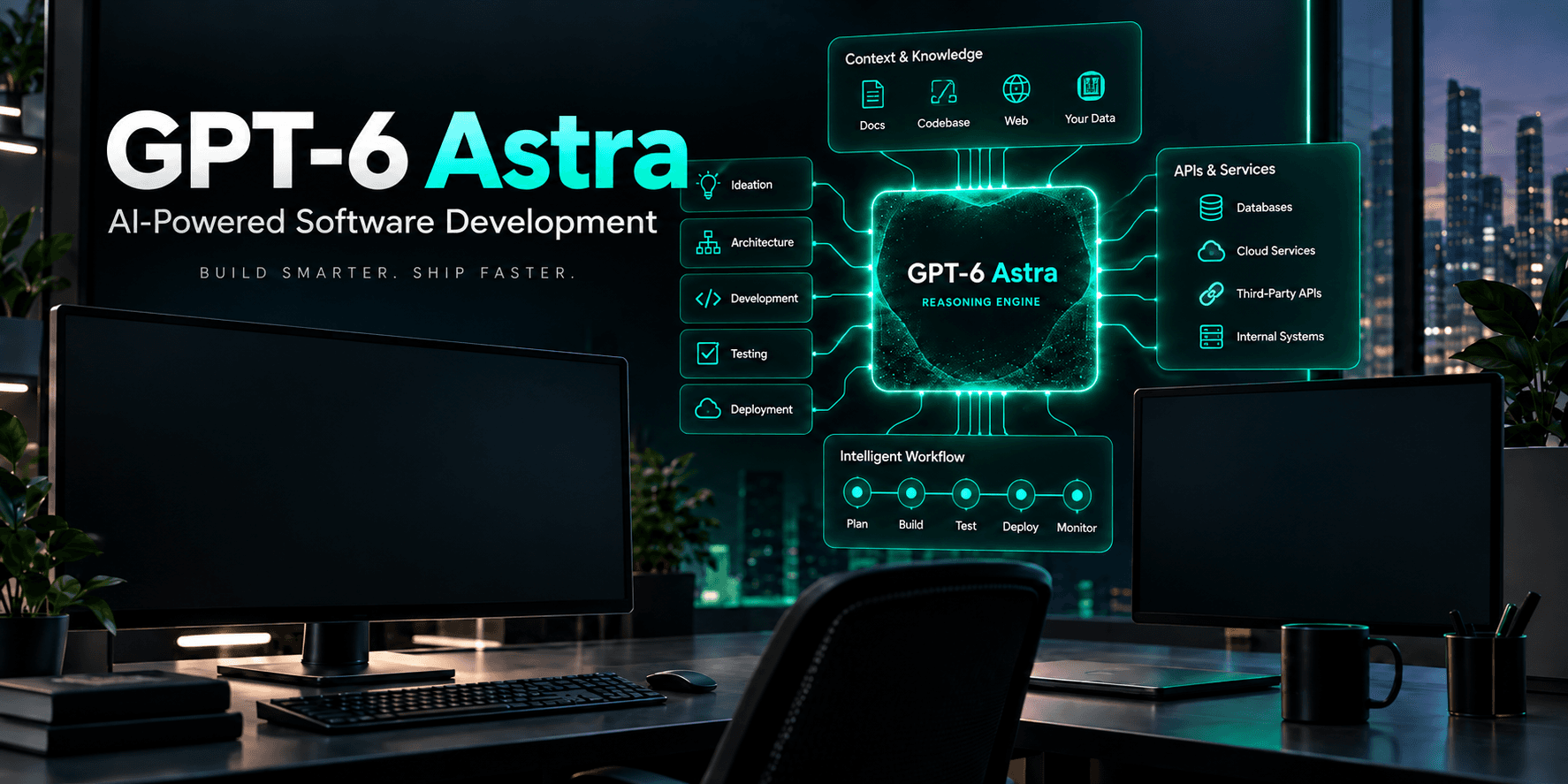
Software development teams have spent the last few years using AI mainly as an assistant. Developers ask for code, debug an issue, generate documentation, or get help understanding an unfamiliar framework. GPT-6 Astra pushes that idea toward something broader: AI that can participate in longer, connected workflows rather than handling only isolated prompts.
OpenAI introduced GPT-6 Astra on September 3, 2026, positioning it as its most capable model for complex reasoning, software engineering, research, computer use, and professional work. The model is also designed to handle changing requirements while maintaining awareness of the larger task.
For businesses, the interesting question is therefore not simply, “Can Astra write better code?” The more useful question is how GPT-6 Astra for software development could change the way companies design applications, automate workflows, build AI agents, maintain codebases, and connect AI with real business systems.
What Is GPT-6 Astra for Software Development?
GPT-6 Astra is OpenAI's latest model designed for difficult end-to-end work. According to OpenAI's official documentation, it is intended for complex reasoning, coding, computer use, research, and document creation rather than only conversational tasks. OpenAI’s official GPT-6 Astra announcement
For developers, one of the most significant specifications is its 1,050,000-token context window combined with a maximum output of 128,000 tokens. That amount of context can be valuable when an AI system needs to consider a large codebase, technical documentation, API specifications, project requirements, logs, or other connected information during the same workflow. GPT-6 Astra API model specifications
A large context window does not automatically make software reliable. What it does provide is more room for relevant information. Instead of showing a coding model one function at a time, development teams can potentially give it a much broader understanding of how modules, dependencies, documentation, requirements, and business rules relate to one another.
That matters for companies like those working with Kodexity’s software and AI development services, where a project may involve a React or Next.js frontend, Node.js or Python backend, databases, APIs, cloud infrastructure, and AI capabilities working together rather than as separate pieces.
Key GPT-6 Astra Features for Software Development Teams
One important development is Astra's ability to work through complex, multi-step tasks. Traditional AI coding interactions often look like a series of disconnected requests. A developer asks for a component, then asks for an API, then explains the database, then corrects something the model forgot earlier.
Astra is designed to maintain the broader objective more effectively. OpenAI also introduced mid-turn steering, which allows new instructions to be provided while Astra is already working. That could be useful during development when requirements change, a developer discovers a constraint, or the original implementation needs to be adjusted without abandoning completed work. OpenAI’s GPT-6 Astra developer guidance
Another feature is asynchronous tool calling. Astra can continue reasoning or work on independent parts of a request while an application is waiting for another tool to return a result. The application still controls tool execution, but the model does not necessarily have to treat every external operation as a complete stop in its workflow.
Computer use is equally important. Modern software workflows rarely happen only inside source code. Developers work across browsers, dashboards, documentation, testing environments, project-management platforms, cloud consoles, and internal tools. Astra's stronger computer-use capabilities create opportunities for AI systems that can operate across those environments when appropriate permissions and safeguards are provided.
These capabilities make GPT-6 Astra for software development particularly interesting for agentic applications. Instead of building an AI feature that only answers a question, developers can design systems in which the model understands a goal, retrieves information, calls approved tools, processes results, and prepares the next action.
How GPT-6 Astra Can Change Software Development in Practice
Consider a development team maintaining a large SaaS platform. A customer reports that invoices occasionally fail after a specific account configuration. Solving the problem might require reading the support ticket, checking documentation, understanding several backend services, examining logs, identifying the affected code, proposing a fix, generating tests, and documenting the change.
A conventional coding assistant can help with individual stages. Astra's value proposition is more about connecting those stages into one coherent workflow. A developer could provide the relevant project context and ask the model to investigate the issue while preserving the original business requirement throughout the process.
The same approach could help with legacy software. Businesses frequently have applications with years of undocumented code. Before modifying them, engineers must understand dependencies and identify which apparently small changes could affect other parts of the system. A model capable of processing broader project context can assist with this investigation, although experienced developers still need to review architectural and production decisions.
AI can also improve testing and QA workflows. Astra could examine implementation requirements, identify likely edge cases, prepare tests, compare expected behavior with results, and help summarize failures. This does not remove the need for proper QA, but it can reduce repetitive work and give engineering teams more time for problems requiring deeper judgment.
Kodexity's own service model provides a useful example of where this could fit. Its development process covers discovery, architecture, development, QA, deployment, and post-launch support rather than treating coding as an isolated activity. A system like Astra becomes more useful when AI participates across several connected stages instead of being limited to autocomplete.
You can see the same end-to-end approach in Kodexity’s company and engineering approach, which covers frontend technologies, backend development, databases, AWS infrastructure, Docker, and OpenAI-powered features. Astra could potentially support teams working across several of these layers while keeping the original product objective in context.
GPT-6 Astra Use Cases for Businesses in 2026
The most valuable business applications may come from combining software development with operational automation. Imagine a B2B company receiving customer requests through email, support tickets, uploaded PDFs, and an internal CRM. Employees currently move between different systems to understand each request and determine what should happen next.
A custom Astra-powered application could analyze the incoming request, retrieve approved customer information, read relevant documents, prepare a recommended response, and suggest an action inside the business workflow. Human approval could remain mandatory before sensitive actions are performed.
Document-heavy businesses are another strong example. An organization may have thousands of policies, reports, proposals, contracts, or technical files. A properly engineered AI application can combine retrieval systems with large language models so employees can ask useful questions without manually searching across multiple repositories.
SaaS companies could use Astra to create more capable in-product assistants. Instead of a chatbot that simply answers FAQs, an assistant could understand the user's account context, retrieve product data, explain a result, create a report, or trigger an approved workflow through an API.
For example, Kodexity's portfolio includes products such as a FinTech Dashboard and an AI Content Studio. Explore Kodexity’s software and AI project portfolio A financial dashboard using an Astra-based layer could potentially allow a user to ask natural-language questions about available analytics, generate summaries, or prepare reports while the underlying application continues to control permissions and financial data access.
DevOps is another practical area. Astra could assist with log interpretation, incident summaries, infrastructure documentation, deployment analysis, or troubleshooting. It should not simply receive unrestricted control over production infrastructure. Access policies, approval steps, logging, observability, and fallback systems remain essential.
That distinction matters. Effective AI integration is not simply connecting an API key to a website. Kodexity's AI integration, cloud, web development and DevOps capabilities show the surrounding engineering that production AI applications typically require, including APIs, backend systems, scalable infrastructure, monitoring, and security controls.
Should Businesses Adopt GPT-6 Astra for Software Development?
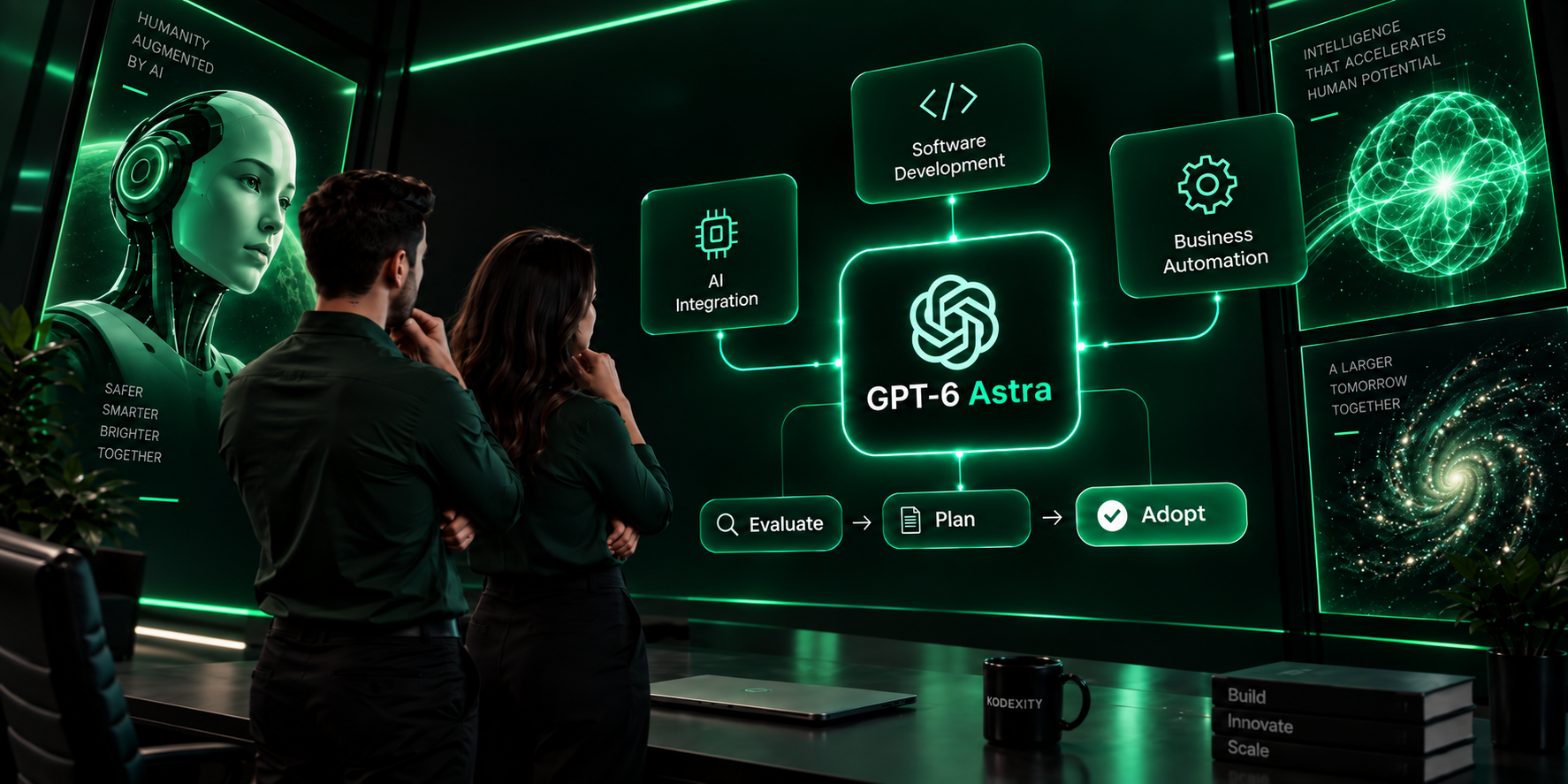
GPT-6 Astra is promising, but businesses should adopt it because a real workflow benefits from it, not because GPT-6 is new. OpenAI's rollout is also still progressing across its products and plans, so availability can differ depending on how and where Astra is being used.
A good starting point is to identify work that combines significant context, repeated manual effort, multiple software systems, and human decision-making. Those are often better AI opportunities than adding a generic chatbot to a homepage.
Security also deserves serious attention. AI agents that can access tools or computer environments need narrowly defined permissions, audit logs, human approval for sensitive actions, protection against prompt injection, and careful testing. OpenAI has itself introduced additional monitoring around Astra because more capable agentic systems create greater consequences when instructions are misunderstood.
The broader lesson is that GPT-6 Astra for software development is less about replacing developers and more about expanding what development teams can automate and coordinate. Developers still determine architecture, business rules, security boundaries, deployment strategy, and whether an AI system should be used at all.
For businesses exploring that transition, working with a technical partner can help separate useful AI applications from unnecessary complexity. Kodexity combines web development, mobile applications, AI integration, cloud solutions, and DevOps, making it possible to design the AI layer together with the software and infrastructure around it.
GPT-6 Astra may make AI systems more capable, but the quality of a production application will still depend on how intelligently those capabilities are designed around a real business problem. The companies that benefit most are unlikely to be those that add AI everywhere. They will be the ones that know exactly where AI removes friction, improves decision-making, or enables a workflow that was previously too expensive or complicated to build.