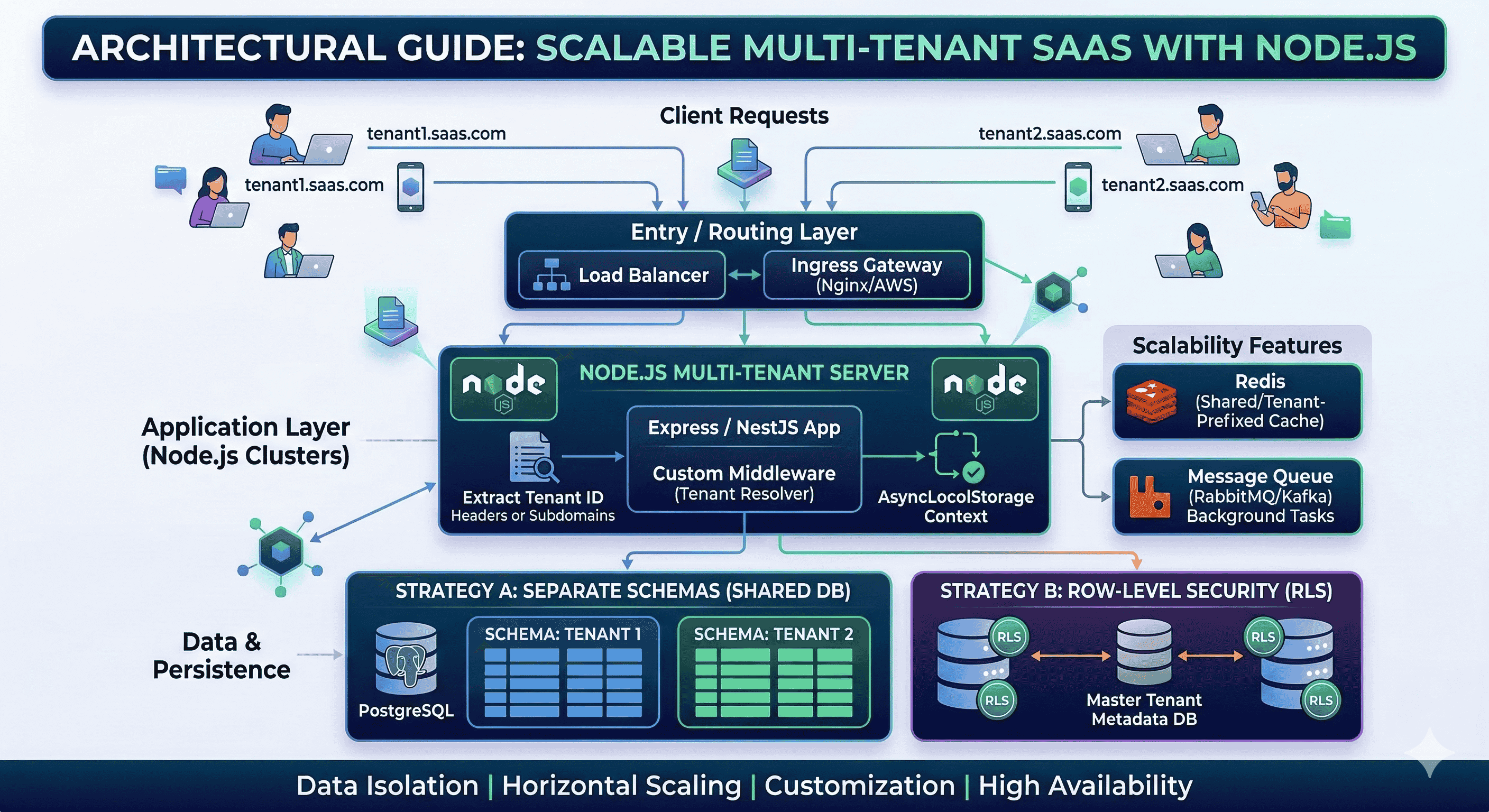
Development of a Software as a Service (SaaS) platform is comparable to operating a large hotel. There is only one building (code), but hundreds of guests (tenants) occupying rooms. The guests must have their individual privacy, individual keys, and individual space but have common plumbing and electricity.
The success of many SaaS products is based on multi tenant architectures. It does not matter whether you are creating a startup minimum viable product or enterprise-scale solutions - the selection of an architecture plays a very important role in how well your application performs and scales as it grows. In this tutorial, we are going to explore in detail the process of architecture, security and scaling of a Multi-Tenant SaaS based on Node.js.
What is Multi-Tenancy? Realizing the Imaginability of SaaS Scalability.
Multi-tenancy is a multi-customer software architecture where one software application serves many customers. All customers are referred to as tenants and the platform has to make sure that the data, processes and settings of each tenant are not shared with the other tenants.
Multi-tenancy also means that you can run the same code with all of your clients compared to traditional software where you have to install a separate instance of your software with each client. There are several examples of SaaS giants, such as Slack, Shopify, and Salesforce, that have prospered on this model because it saves money and makes it easy to maintain.
What is Multi-Tenancy and Why is it the Gold Standard of SaaS?
Multi-tenancy is frequently used as a model of SaaS platforms due to several factors:
Cost Efficiency: A shared environment minimizes the cost of resource allocation as compared to having to provision individual instances to individual tenants.
Simplified Maintenance: All tenants are now using the same version of the application, which makes the process of updating the codebase far simpler, as there is only 1 deployment and it is updated across all tenants.
Scalability: The ability to add thousands of tenants without changing the basic infrastructure means that your SaaS platform can grow.
Multi-tenancy is critical in developing a SaaS product that is scalable to an effective degree without developing a complex and costly system.
Single-Tenant and Multi-tenant architecture: Comparative in-depth analysis.
The first thing you need to do before you begin to write any code is to determine what kind of architecture you desire to use: the single-tenant type or multi-tenant one.
In single-tenant architecture, there is an isolated instance of each customer (tenant) of the application and database. Imagine it is a row of houses, each house has its garden and walls and in case one house burns down, it does not affect the rest of the houses. Although this method is the best in making sure that data is completely isolated, it is expensive and not scalable.
Conversely, in a multi-tenant architecture, two or more tenants can access an identical instance of an application and database just like in an apartment complex. This is much more economical, however, it involves powerful mechanisms in making sure that the data of one tenant does not leak into another.Multi-tenancy is usually the obvious choice in the case of contemporary SaaS applications. It enables you to expand laterally, reduce expenses and ease the maintenance, which is critical to an expanding SaaS platform.
Top 5 Technical Problems when designing Multi-tenant Systems.
A multi-tenant system is not a design and implementation that comes without challenges. The major barriers that you will encounter include:
Data Isolation
The biggest issue with the multi-tenant systems is avoiding violations of the privacy of Tenant B by the Tenant A. In order to achieve appropriate data isolation in a shared environment, it is essential to address the provision of security and privacy. It can be achieved most of the time by introducing a stern policy when accessing data and verifying at each point of information processing.
The Noisy Neighbor Problem
Noisy Neighbor problem occurs when the heavy usage of the resources by one tenant compromises the performance of other tenants such as CPU or memory. This problem may slack down the application and create a bad user experience, and it is worthwhile to spend resources wisely and make the system capable of spurring an increase in tenant activity without damaging its performance.
Schema Migrations
Multi-tenancy presents a complexity issue with respect to migration of databases. When you are having different databases with each tenant, you will need to update hundreds or thousands of databases at the same time without crashing anything. When tenants have the same schema, then it is important to plan the implementation of the changes to each of the tenants so that it will not interfere with the data of the tenant.
Customization
Each tenant might desire his or her platform to appear or be otherwise. There might be those who desire a tailored theme whereas others might need to have custom workflows and integrations. A flexible system which enables you to customize without affecting the core functionality can prove to be tricky and this is especially so as your platform grows.
Security Leaks
Multi-tenant systems are vulnerable to security leaks that are disastrous. A single bug in your middleware, say, may lead to making all data of the tenants publicly available. Strict security protocols should be implemented to make sure that the data belonging to every tenant is not accessed without authorization.
Designing Strong Multi-tenant Architectures in Node.js.
Node.js does not have a problem that fits into SaaS applications because it can create applications that are both high-concurrency and scalable. It is non-blocking, event-based and hence suitable to serve thousands of concurrent requests.
Async Local Storage is a major aspect of Node.js that is useful in managing multi-tenancy. You can store the tenant context (e.g. the ID of the current tenant) and access it at another point in a request lifecycle, which extends its lifecycle across the application. This makes it much easier to maintain tenant data all over the codebase.
In order to develop a strong multi-tenant system, you must make sure that tenant context is present in every step of handling a request. It is against this background that you will be able to formulate the tenant and scope data.
Clean Code Blueprint: The Best Folder Structure for Multi-Tenancy
A clean and organized folder structure is essential when building a multi-tenant system, especially as the complexity of the application increases. Here is a recommended folder structure that ensures modularity and clarity:
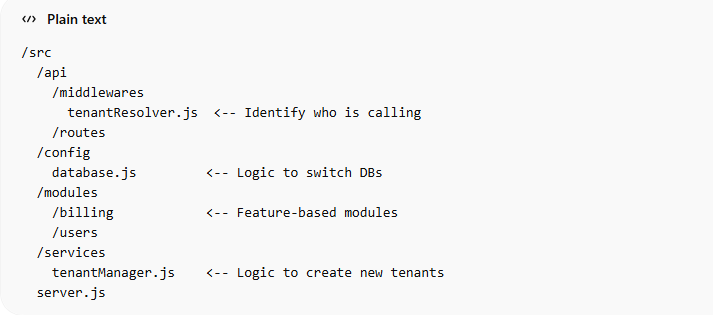
This structure ensures that tenant-specific logic is separated into distinct modules, making it easier to maintain and scale as the platform grows.
Tenant Identification Strategies: Headers, Subdomains, and Beyond
In order to determine the tenant who is making a request, one can use a number of strategies:
- Subdomains (Recommended): Subdomains are a tidy and easy to use mechanism of determining who is tenanted. As an example, tenant1.your-saas.com will be directed to the data of tenant 1. It is a very efficient and simple approach.
- Custom Headers: Alternatively, you may send a custom header, which contains the identifier of the tenant, e.g. X-Tenant-ID. It is also an active way of APIs or mobile apps.
- JWT Claims: Encoding the JWT token on authentication can be done by the tenant_id. It is among the safest processes because the context of the tenant can be accessed in the authentication token.
Step-by-Step Guide: Building a Custom Tenant Resolver Middleware
The tenant resolver middleware intercepts incoming requests and identifies the tenant. Here is a simple example of how you can implement this middleware:
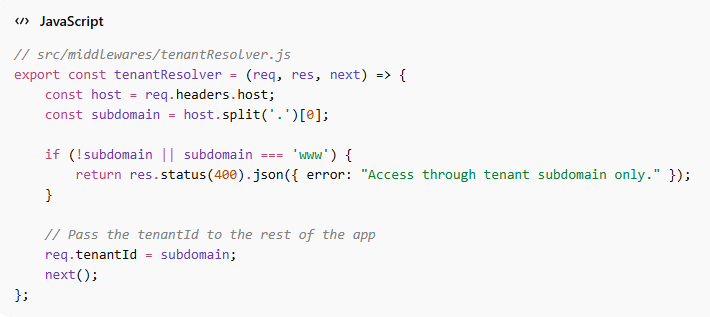
his middleware extracts the tenant ID from the subdomain and attaches it to the request object, making it accessible throughout the application.
Database Architecture Options: Shared Schema vs. Isolated Databases
The right database architecture depends on the way your multi-tenant SaaS platform will scale. There are two principal points of thought you can take:
Shared Schema (Logical Isolation)
All tenants are placed in the same tables as they have the same schema and are separated by tenant_id column. It is an inexpensive and easy to use model with the risk of data leaks in case the tenant_id is not filtered adequately.
Physical isolation (Separate Database)
In case of separate databases, a single tenant gets a single database which is as isolated as possible. This is a safer and scalable choice that places an increased burden on the infrastructure and maintenance. It is most appropriate with the high-end applications, like sensitive data (e.g., healthcare or finance).
Implementing Dynamic Database Connections in Node.js
If you choose separate databases for each tenant, you need to implement dynamic database connections. This allows your application to switch between databases depending on the tenant making the request. Here’s an example of how to manage dynamic database connections in Node.js:
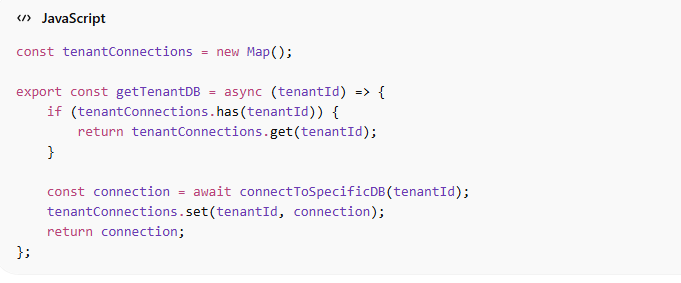
resources and preventing connection overload.
Hardening SaaS Security: Advanced Authentication & Authorization
Authentication and authorization play a very important role in a multi-tenant application. Not only should you check on the identity of the user but also whether the user is who they claim to be in addition to whether they have the right to access the data requested. Tenant-Scoped Authorization can be used to make sure that only the user can access the data of their tenant.
Always remember to add the JWT with the tenantId claim, and when a user attempts to do something (e.g. delete a record), verify that the record is owned by the tenant of which the token of the user is part of.Solving the Noisy Neighbor Problem: Scaling and Performance TipsWhen the performance of one of the tenants begins to interfere with the performance of the other tenants, you must reduce the Noisy Neighbor problem. In order to make sure that a tenant will use only resources that are assigned to him/her, rate limiting through Redis is implemented. Resource quotas can also be configured to restrict the number of disk space or the number of users a tenant is allowed up to depending on the subscription plan.
Enterprise Monitoring: Awareness of Tenant Logging and Auditing.
Logging and monitoring of multi-tenant systems should have tenant context. Whenever a problem arises you should be able to know who the tenant is, the one who caused the problem. Record the requests with the help of such tools as Winston or Pino and add the tenant ID automatically to each log entry. And, have audit trails as to who did what and when of all tenants, which is critical to applications on the enterprise level.
Cloud-Ready Infrastructure: SaaS Deployment Instructions.
Your infrastructure has to be stateless to be able to scale and maintain your multi-tenant application. This implies that your software should not store files on the hard disk of the server. As an alternative, cloud storage such as AWS S3 can be used.
Docker can also be used to put your application in a container, so it will run identically in all the machines be it locally or in the cloud. In large scale deployments Kubernetes (K8s) can be used to scale and orchestrate containers automatically.
Real-World SaaS Flow: From Automated Onboarding to Active Workspace
For a seamless experience, automate your onboarding flow. Here’s an ideal process:
- User signs up on your website.
- An automation script runs in the background to set up the tenant’s environment.
- A new database schema is created instantly.
- A welcome email is sent, directing them to their unique URL: new-client.your-saas.com.
This process should be instant and completely automated.
Future-Proofing Your Architecture: Lessons from Large-Scale Projects
In creating a multi-tenant SaaS application, the following are some of the lessons of large scale projects:
- Don’t Over-engineer Early: Use a common schema when testing an idea. It is always possible to move to different databases in the future.
- Automate All Things: You will not be able to manually migrate, do back up and scaling as your tenant base expands. Migrate and update database using automated tools such as Knex and Prisma.
- Strategy: Growth: Take the long road. Scalability and isolation Build your platform with scalability and isolation in mind, and your platform will be future-ready.