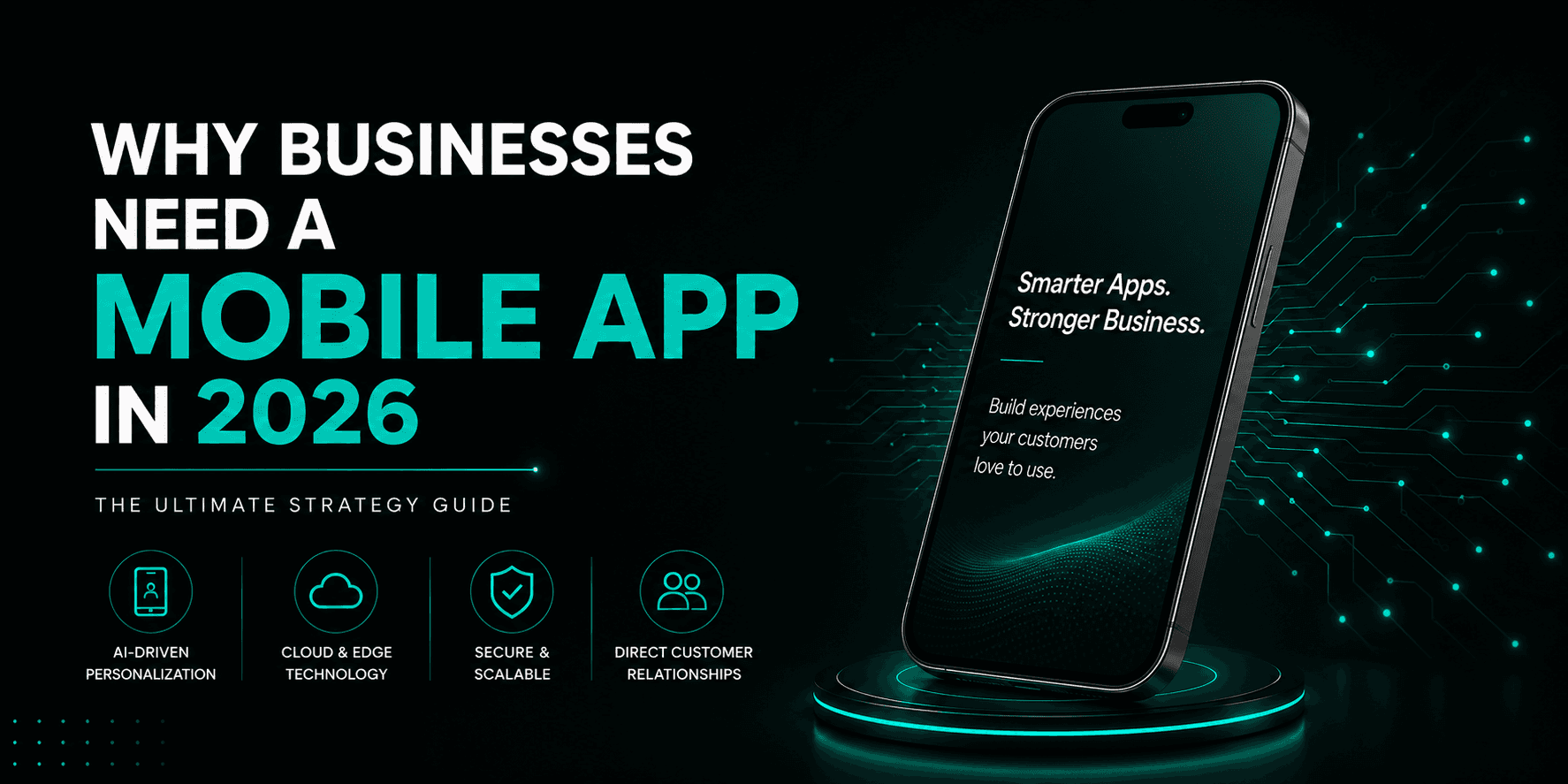
The mobile landscape has changed dramatically by 2026. Customers no longer judge a business only by its product, price, or website. They judge how quickly they can get what they need, how intelligently a digital experience responds to them, and how little effort is required to complete an action.
AI-powered recommendations, instant support, personalized interfaces, biometric access, real-time updates, and zero-friction experiences are becoming normal expectations. A basic responsive website remains important, but it is no longer the complete answer for businesses that want to build deeper digital relationships.
A well-designed mobile application can put your product or service directly into the customer's daily routine. It can create faster interactions, personalize experiences, simplify operations, improve retention, and establish a direct communication channel that businesses have far greater control over.
This is the real reason Why Businesses Need a Mobile App in 2026. The goal is not simply to launch an app. The goal is to build a digital product that creates measurable business value.
Why Businesses Need a Mobile App in 2026: Moving Beyond Responsive Websites
For years, having a mobile-friendly website was enough to demonstrate that a company understood the mobile market. That standard has changed. Users now expect experiences that are designed around mobile behavior rather than desktop websites simply being resized for smaller screens. An app can provide faster navigation, persistent sessions, biometric authentication, push notifications, offline capabilities, and access to device-level functionality. These features can turn repetitive customer journeys into simple, one-tap interactions.
This is particularly important for businesses where customers return frequently. An e-commerce company can make repeat purchases easier. A financial platform can provide instant account access. A logistics company can deliver real-time tracking. A SaaS business can allow customers to monitor critical information while away from their desks. The strongest applications are not built because a business wants to “have an app”; they are built because an app can make an important task easier.
The next step is personalization. Traditional websites often present broadly similar experiences to every visitor, while modern mobile products can adapt based on behavior, preferences, history, and context. AI can help recommend relevant products, prioritize frequently used features, provide intelligent search, automate support, and surface information at the right moment. Kodexity's mobile app development services focus on high-performance cross-platform experiences, including Flutter and React Native, with features such as push notifications and offline-first architecture.
AI-Powered Personalization Is Changing the Mobile Experience
Personalization in 2026 goes far beyond addressing customers by their first names. AI can analyze interaction patterns and help applications understand what users are trying to accomplish. Instead of forcing someone to search through menus, an intelligent app can prioritize relevant actions, suggest the next step, or provide contextual assistance. This makes the experience feel less like navigating software and more like interacting with a product that understands the user.
Consider an online retailer. A basic application may display a product catalog and checkout process. An AI-enhanced application can learn which categories a customer explores, identify purchasing patterns, improve product discovery, and provide more relevant recommendations. The same principle can work in B2B software, healthcare platforms, education products, financial services, and internal enterprise systems. Personalization becomes valuable when it reduces effort and improves outcomes.
AI can also create operational advantages behind the interface. Intelligent chat assistants can handle routine questions, predictive systems can identify patterns, and automation can reduce repetitive work for employees. However, AI should have a clear purpose. Adding an AI chatbot simply because it is fashionable does not create meaningful value. The better approach is to identify friction within the customer or employee journey and use AI where it can genuinely make that journey faster, smarter, or more useful.
Modern Architecture, Edge Technology, and Cloud Remove Friction
The quality of a mobile experience depends on more than visual design. Architecture determines how reliably the application performs when the user base grows, traffic increases, or the product becomes more complex. Modern businesses need technology choices that support speed, scalability, security, and maintainability from the beginning. Frameworks such as Flutter can support cross-platform mobile development, while React and Next.js can provide a strong foundation for connected web experiences and digital products.
Cloud infrastructure makes it possible to scale resources as demand changes instead of designing systems around a fixed level of traffic. Edge technology can further reduce latency by moving certain delivery and processing capabilities closer to users. Combined with caching, optimized APIs, efficient databases, and appropriate application architecture, these approaches can create noticeably smoother experiences. Performance matters because users do not experience your architecture directly; they experience how quickly the product responds to their actions.
This is where choosing the right software engineering partner becomes important. Kodexity combines modern technologies such as React, Next.js, Node.js, Python, AWS, Docker, Flutter, and AI integrations across its development services. Businesses can therefore approach mobile development as part of a broader digital ecosystem rather than treating the app as an isolated product. A strong architecture should allow mobile, web, APIs, AI systems, databases, and cloud infrastructure to work together as the business evolves.
Mobile Apps Build Direct Customer Relationships and Long-Term Value
One of the biggest strategic advantages of an app is the ability to build a more direct relationship with customers. Businesses that rely entirely on social media platforms and paid advertising are dependent on third-party algorithms. A change in reach, targeting rules, or advertising costs can immediately affect customer acquisition. An app gives a business another channel that it can manage directly.
The difference is especially important for retention. Instead of repeatedly paying to bring an existing customer back through advertising, businesses can provide useful reasons for customers to return to the application. Personalized recommendations, account information, loyalty programs, real-time updates, saved preferences, subscriptions, and permission-based notifications can make the product part of a customer's routine. A mobile app should therefore be viewed as a customer experience platform, not merely another marketing channel. Current industry discussion also highlights direct communication, personalization, automation, and convenience as important business benefits of mobile applications.
That does not mean websites, SEO, social media, or paid advertising are becoming irrelevant. They remain powerful acquisition channels. The smarter strategy is to connect them. Search and social can introduce customers to the brand, while the mobile application can provide the deeper experience after that first interaction. Businesses that build this ecosystem can gradually move from renting attention on third-party platforms toward creating an owned digital relationship with their audience. For a practical perspective on the importance of performance in digital experiences, MDN's Web Performance Guide provides useful technical guidance on responsiveness, loading, and user-perceived performance.
Building the Right Mobile App Strategy in 2026
A successful mobile application starts with a business problem, not a technology stack. Before development begins, leaders should identify who the application is for, what problem it solves, why customers would use it repeatedly, and which business metric it should improve. Depending on the company, that metric could be customer retention, conversion rate, subscription growth, operational efficiency, service delivery, or customer satisfaction.
The next step is to prioritize. Trying to launch dozens of features at once can increase cost and complexity without proving whether users actually need them. A focused MVP can validate the core concept, collect behavioral data, and reveal where improvements are needed. Once the foundation is proven, new capabilities can be introduced based on real customer feedback rather than assumptions.
Security and scalability should also be considered from day one. Authentication, data protection, API security, monitoring, cloud infrastructure, analytics, backups, and performance testing should be part of the architecture rather than afterthoughts. Kodexity follows a structured Discovery, Strategy, Build, and Launch approach, helping businesses define the right problem and technology direction before moving into development.
Conclusion
The question in 2026 is no longer simply whether a business should have a mobile app. It is whether the business is prepared to meet customers with the speed, personalization, convenience, and intelligence they now expect. A strategically built app can become a powerful engine for engagement, retention, automation, and direct customer relationships.
Businesses that start with a clear purpose and invest in scalable architecture can turn mobile technology from an expense into a long-term digital asset. The opportunity is not just to build an app, but to build a product that becomes difficult for customers to live without.
Ready to build your next digital product? Partner with Kodexity's software development team to engineer a scalable mobile experience, integrate AI, and build the digital infrastructure your business needs for 2026 and beyond.